

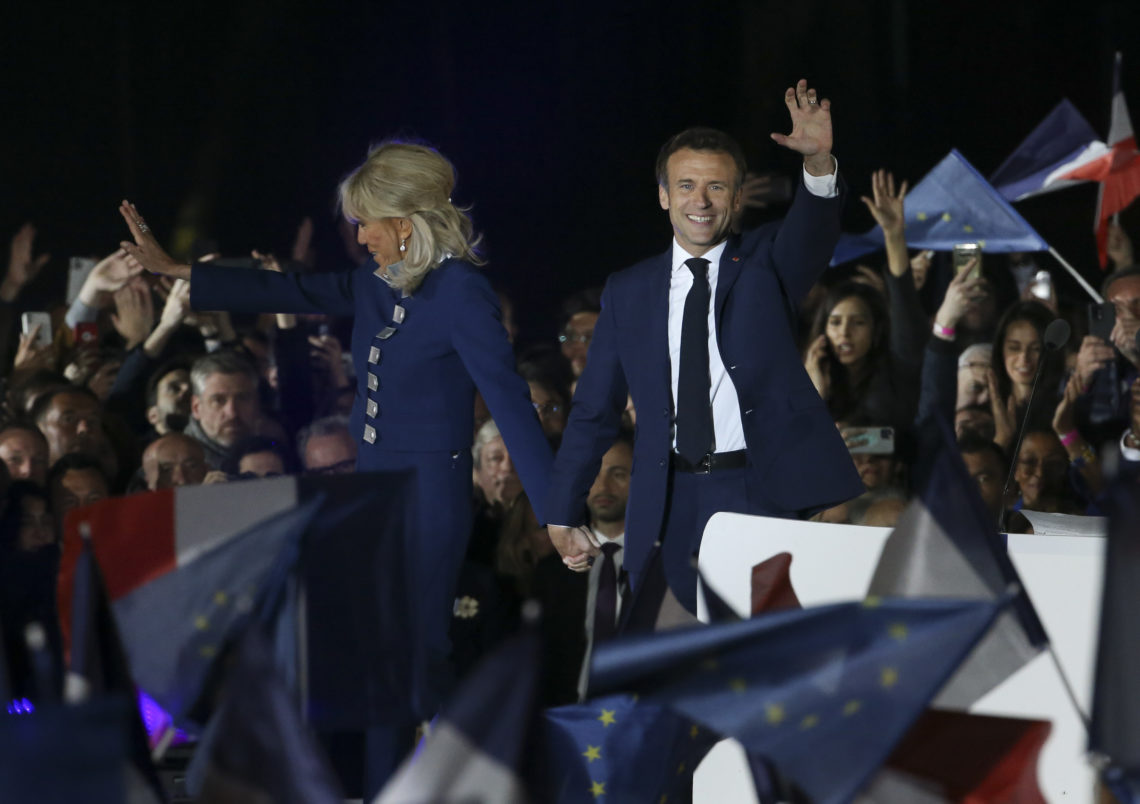


Yesterday, Sunday April 24, French people took to the polls to vote in the second round of the French presidential elections. It seems it was a remake of the 2017 elections: Marine Le Pen and Emmanuel Macron facing off.
At 20.00 French time (19.00 BST), the first estimations dropped: Macron would be reelected for another five-year mandate. While many people sighed with relief, the results showed that Le Pen was more popular than in 2017.
The final results
French people assembled on the Champs de Mars in Paris to watch the results drop and hear the candidates speak.
Macron won with 58.54% of the popular vote, while Mrs Le Pen came in second with 41,46% of the popular vote. Le Pen considered her loss a victory, still winning 13 million votes. Indeed, in 2017, Le Pen won 33,90% of the vote whilst Mr Macron won 66,10%. These numbers show again that there is a divided France. No traditional parties were represented in the final run off.
Furthermore, the turnout was under 72%, one of the lowest turnouts in run off elections since 1969. Much of France was on holiday this past Sunday. However, many people have said that neither of the candidates represented them.
In his acceptance speech, Mr Macron said that he will work on uniting the French electorate. That is something he needs ahead of the legislative elections coming up in June.
What next for Macron?
Mr Macron is the first incumbent to be reelected in 20 years. There will not be a ceremony for the transfer of power. Instead there will be a small inauguration ceremony. This will be followed by naming a new Prime Minister. The current Prime Minister is Jean Castex and his replacement will be named by May 2.
His upcoming duties will be ceremonial. He will go and visit wounded soldiers and visit the German Chancellor. But you might wonder why? Because it is tradition. It emphasises a strong Franco-German relationship. In 2017, Macron visited Angela Merkel. This time, Macron will be visiting Olaf Scholz.
As mentioned above, Macron will now have to work towards uniting the French electorate ahead of the legislative elections. After a hard five years, with crises such as the gilets jaune, the COVID-19 pandemic and the war in Ukraine, he needs all the votes he can get in order to get the government he would like.
What kind of legislation does he have planned?
One of Macron’s biggest argument during the presidential campaign was purchasing power. During the debate on Wednesday, April 13 , Macron argued for an ‘extraordinary law to address purchasing power.’ This was arguably one of his biggest campaigning arguments.
The president also vowed to combat the rising gas and electricity prices that have been affecting many people. Indeed in an interview he said he wanted ‘to keep a lid on the price of diesel and gasoline in case prices continue to skyrocket.‘
Macron has also said he will increase the purchasing power of civil servants. He even said that the review of salaries and increase of purchasing power will be seen to by the summer.
Finally, one of the last things he campaigned for and will want to put into place was retirement. During the first round he was highly criticised on his argument to push back the legal retiring age from of 62 to 65. This forced him to review his arguments. Instead, he argued for a gradual pushback of the retiring age. There is no doubt that he still plans to reform the retirement system.
These next five years will be crucial for him. He needs to set the leadership of his party, La Republique en Marche, quite quickly if he wants to beat the rising force that is Le Pen’s Rassemblement National. Indeed, Mr Macron will not be allowed to run for a third mandate in five years, as it is forbidden by the French constitution.