



Sofia, the flying telescope has officially stopped flying as it was expensive to fly and maintain, but SOFIA made some incredible discoveries.
SOFIA, the Stratospheric Observatory for Infrared Astronomy, landed for the last time at the end of September. Indeed, the telescope nicknamed SOFIA flew aboard a modified Boeing 747 plane. This flying telescope was a joint mission between NASA and the German Space Agency. It was a unique platform for astronomers to conduct distinctive observations of our universe.
Indeed, the 19-ton and 2.7 m reflecting telescope flew 38,000 to 45,000 feet in the stratosphere. It flew that way, above water vapour to make observations that land-based telescopes could not make. During its 900 flights since its, SOFIA brought back crucial details and observations.
While the plane will no longer fly, its legacy will be studied for many years to come.
What did NASA’s SOFIA telescope do?
SOFIA was created with one particular goal in mind: to study the solar system and beyond in ways that aren’t possible from the ground. Due to the infrared radiation on the ground, many celestial objects are hard to observe and study. However, with SOFIA astronomers had an unobscured view of these celestial objects (planets, nebulas, galaxies etc …) at infrared wavelengths.
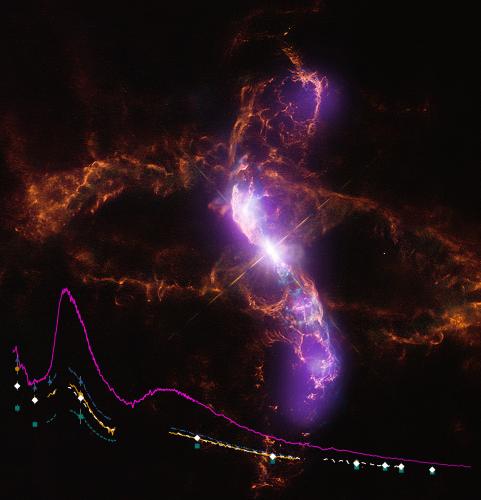
SOFIA first saw light in May 2010 and since then it has captured a multitude of observations. In its 10 hours of overnight flights, it observed star births and deaths, nebulas, and far-away galaxies. Not only that but SOFIA observed the composition of planetary atmospheres and surfaces. In 2020, the SOFIA telescope even discovered H2O molecules on the sunlit surface of the moon.
As a NASA press release states when the Apollo missions ended the moon was thought to be completely dry. It means that water molecules are not limited to deep, dark craters. And is not frozen. This was a discovery for the SOFIA team.
Indeed, with the Artemis missions soon on their way, NASA is eager to go back to the moon. When it gets there it would investigate this water and ice.
Without a telescope like SOFIA, discoveries like these would not have been possible. This was a mobile telescope that could fly from anywhere in the world. Throughout its many flights, it flew from Germany, New Zealand and Chile to name but a few. Flying in the southern hemisphere of the Earth means that the telescope can observe things only observable in the southern hemisphere.
NASA SOFIA telescope lands for the last time
After 8 years of flying NASA and the Deutsches Zentrum für Luft- und Raumfahrt (DLR) announced it would stop SOFIA’s research at the end of September. Even if the telescope made some important discoveries and observations, it cost NASA an astounding $85 million a year.

It has become costly to fly the plane for 10 hours, and have a maintenance crew for the plane, pilots, staff, engineers etc. Furthermore, the budget for SOFIA had been under scrutiny for a couple of years.
The plane might be grounded from now on but SOFIA’s legacy will remain and will be analysed and used for years to come. Germans and Americans have all played a part in the smooth running of this mission.