



The UCU has announced that university staff across the UK will once again be taking strike action. In a record-breaking ballot, 60.2% of staff cast votes, and 84.9% voted for strike action. These results have enabled the UCU to call a national strike, rather than industrial action within individual universities. These strikes could involve up to 70,000 members of staff nationwide, in nearly every university.
Why are university staff pursuing industrial action?
The UCU has stated that the results of the vote are a ‘clear indication of anger’ felt by staff. Employers have cut the guaranteed retirement income by 35% on average. In addition, a third of staff are on temporary contract. The union is asking for a ‘meaningful pay rise’ above the 3% offered this year, in order to account for the 10% inflation and the cost of living crisis. The union also raised concerns about heavy workloads.
UCU general secretary Jo Grady said: ‘The vice chancellors who run universities have repeatedly and in a coordinated fashion come after our members. Well, now it’s 150 bosses against 70,000 university workers who are ready and willing to bring the entire sector to a standstill, if serious negotiations don’t start very soon.
‘University staff are crucial workers in communities up and down the UK. They are sending a clear message that they will not accept falling pay, insecure employment and attacks on pensions. They know their power and are ready to take back what is theirs from a sector raking in tens of billions of pounds.’
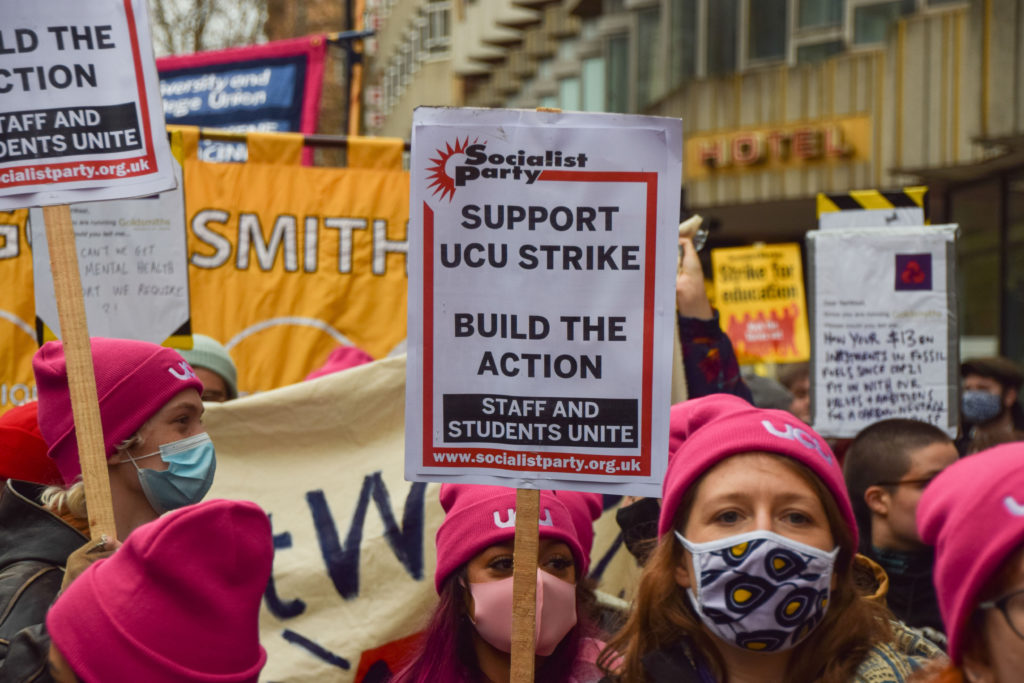
In response, Raj Jethwa, chief executive of the UCEA (Universities and Colleges Employers Association said, ‘While threatening industrial action will not create new money for the sector, UCEA and its member HE (higher education) institutions want to work with UCU and other trade unions to support staff and students and to avoid disruptive industrial action. However, there needs to be a realistic assessment of what is possible.’ He added that there is ‘no sector affordability’ to support an enhanced pay rise.
‘We are all concerned for those on lower incomes, who are disproportionately impacted by inflation and cost of living pressures,’ he said. “That is why the 2022-23 New JNCHES (New Joint Negotiating Committee for Higher Education Staff) pay award included an uplift of up to 9% for those on the lowest points of the pay spine, and why UCEA worked with employers to implement the uplift at the earliest opportunity following the conclusion of the New JNCHES processes.’
What do the strikes mean for students?
If the strikes go forward, students may face disruptions to their degrees, such as cancellations of lectures and seminars. However, no dates have been set for the strikes yet, and depending on how negotiations proceed, it’s possible that no industrial action will occur. Students can look into the UCU leadership at their universities for further information.
See also: OfS Issues Guidance For Universities Continuing Blended Learning Post-Pandemic